Weekly Lesson Planner for Multiple Children
Plan one homeschool week for two, three or four kids on a single page, and write the shared read-aloud once instead of four times.
Free printable: 3 sample pages, US Letter · A4
Why one page for everyone works better
Separate planners per child look tidy, but during the day you juggle all of them at once. One weekly page with a column per child shows the whole household: who is working alone, who needs you, and where you can teach two children together.
The Together column
Most families teach some subjects to everyone at once: read-alouds, history, science demonstrations, art, music, nature study, memory work. Writing these once in a shared column shortens every child's list and makes the family rhythm visible.
A rule of thumb: if a subject can be taught to everyone with different follow-up work, it goes in Together. The follow-up goes in each child's column.
A 20-minute weekly planning routine
- Check last week. 5 minutes. Anything unticked either moves to this week or gets dropped on purpose. Note it on the new page.
- Write fixed events first. 2 minutes. Co-op, outside lessons, appointments. These decide which days are light.
- Fill the Together column. 3 minutes. Read-aloud chapters, the history or science topic, the art project.
- Fill each child's column with lesson numbers. 8 minutes. Write "Math L.37" rather than a description; the curriculum already holds the detail.
- Leave Friday lighter. 2 minutes. Friday takes whatever slipped earlier in the week, so the plan stays honest.
Your curriculum tracker tells you which lesson is next for each child.
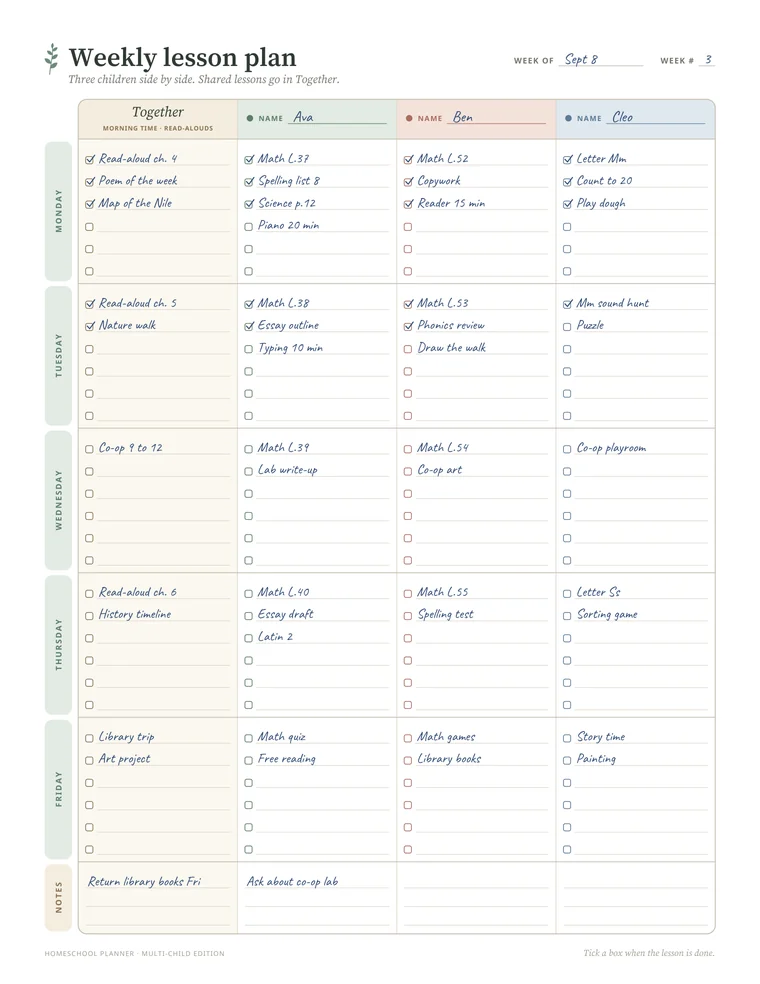
Example: three children, one week
| Together | Ava, 11 | Ben, 8 | Cleo, 5 | |
|---|---|---|---|---|
| Mon | Read-aloud ch. 4 · Poem · Map of the Nile | Math L.37 · Spelling list 8 · Science p.12 | Math L.52 · Copywork · Reader 15 min | Letter Mm · Count to 20 · Play dough |
| Tue | Read-aloud ch. 5 · Nature walk | Math L.38 · Essay outline · Typing 10 min | Math L.53 · Phonics review · Draw the walk | Mm sound hunt · Puzzle |
| Wed | Co-op 9 to 12 | Math L.39 · Lab write-up | Math L.54 · Co-op art | Co-op playroom |
| Thu | Read-aloud ch. 6 · History timeline | Math L.40 · Essay draft · Latin 2 | Math L.55 · Spelling test | Letter Ss · Sorting game |
| Fri | Library trip · Art project | Math quiz · Free reading | Math games · Library books | Story time · Painting |
Made-up names and lessons. The printed page adds a tick box to every line and a Notes row under Friday.
Staggering, so you are not needed by everyone at once
- Pair one child's teacher-led subject with the others' independent work. Mark teacher-led items with a small dot so the pattern is easy to see.
- Put the youngest child's short lessons first, while older children start reading or math practice on their own.
- Give older students a quarter of the daily checklist with their own list. They tick it off; you check it in the evening.
Which layout fits your family
| Family | Weekly page | Column width per child |
|---|---|---|
| 1 child | 1-student page: subjects down the side, days across | 8 subject rows, a tick box per day |
| 2 children | 2-student page | About 2.5 in (6.4 cm), 6 tick lines a day |
| 3 children | 3-student page (in the free sample) | About 1.75 in (4.4 cm), 6 tick lines a day |
| 4 children | 4-student page | About 1.4 in (3.5 cm), 6 tick lines a day |
| 5 or more | 4-student page for the older kids, daily checklist for the little ones | One quarter of the checklist per child |