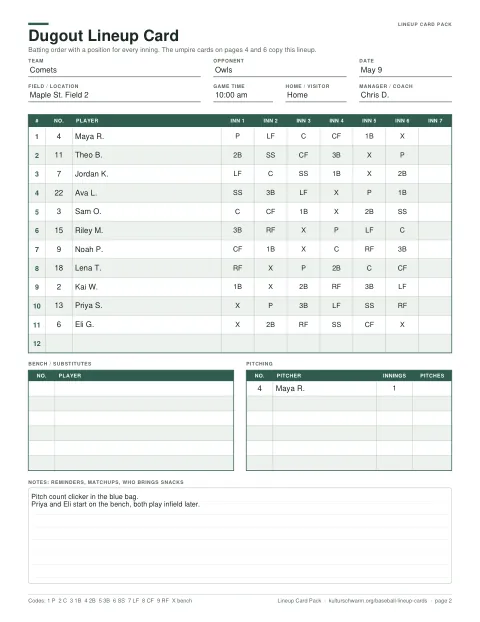
How the rotation is worked out
- Bench first. Each inning, the players with the fewest bench innings so far sit next. Nobody sits twice before everyone has sat once, and nobody sits two innings in a row while others have not.
- Then positions. The fielders for that inning are matched to positions all at once. The match avoids giving anyone the same position twice and moves players between infield and outfield.
- Totals. BN, IF and OF count bench, infield and outfield innings, so you can spot an uneven game before it starts.
The helper does not know who can pitch or catch. Those spots need a coach's judgment and your league's pitching rules, so set them by hand after building. The coverage check tells you right away if a change leaves a position open or doubled.
Reading the chart before the game
- Read across a row to tell a player their whole day at once.
- Read down a column to confirm each position is covered once that inning.
- Compare the BN column. With 11 players and 9 fielders, 2 sit each inning, so over 6 innings there are 12 bench innings to share: one player sits twice, everyone else once.
Position codes
| No. | Code | Position |
|---|---|---|
| 1 | P | Pitcher |
| 2 | C | Catcher |
| 3 | 1B | First base |
| 4 | 2B | Second base |
| 5 | 3B | Third base |
| 6 | SS | Shortstop |
| 7 | LF | Left field |
| 8 | CF | Center field |
| 9 | RF | Right field |
| LC, RC | Left-center and right-center, in ten-fielder formats | |
| X | Bench for that inning |
Need the batting order and an umpire copy too? The lineup card maker uses the same rotation and prints both on one sheet.